

First Large-Scale Study by AI Search Monitoring Platform OtterlyAI Shows YouTube is #2 Social Platform for AI Citations
First analysis of 100 million AI citations across six platforms shows AI search engines favor reference-style video content , and that platform citation behavior varies sharply
Persenbeug, LOWER AUSTRIA, March 02, 2026 (GLOBE NEWSWIRE) -- OtterlyAI, An AI search monitoring and optimization platform, today published findings from its YouTube Citation Study 2026 , the first large-scale study to examine how YouTube content is cited across the six leading AI search platforms.
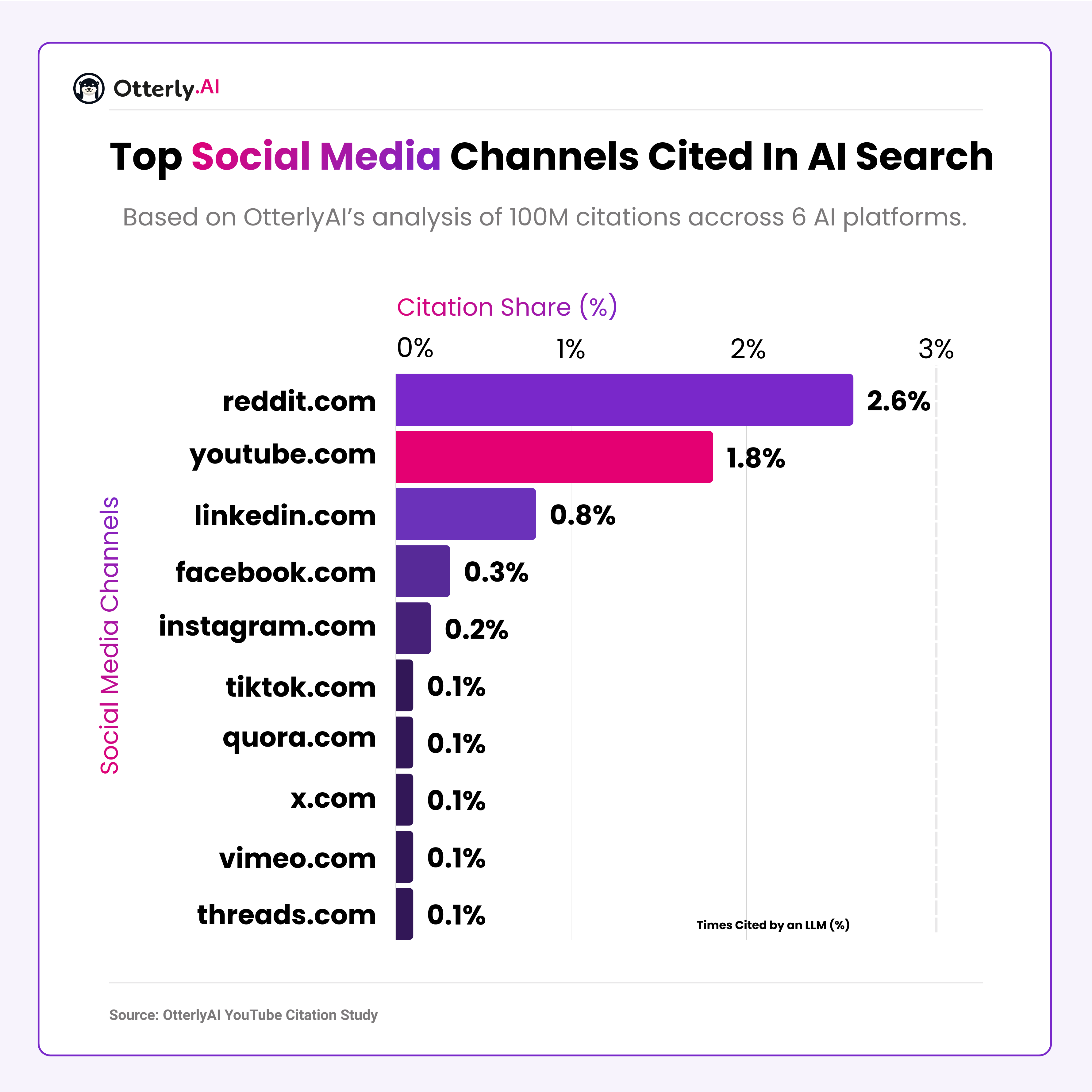
Out of +100 million AI citations observed. 5.5 million came from social media and video platforms. Within that subset, YouTube represented 31.8% of social media citations.
Derived from a dataset of more than 100 million AI citation instances collected over a 30-day period, the research reveals a clear pattern: AI search engines overwhelmingly cite long-form, reference-style YouTube videos, with Shorts accounting for just 5.7% of observed citations. The findings also show that popularity metrics , views, likes, and subscriber count , carry near-zero correlation with citation frequency, challenging a core assumption in content marketing strategy.
Key Findings
- YouTube is the second most-cited social media platform in AI Search, behind only Reddit. Across 5.5 million social media citations in the dataset, YouTube accounted for 31.8% of citation volume. Reddit led at 46.4%. Together, the two platforms represent 78.2% of all social media citations observed across the six AI search platforms analyzed.
- AI search engines regularly cite YouTube videos that most audiences have never found. 40.83% of AI-cited YouTube videos had fewer than 1,000 views at the time of analysis. 36% carried fewer than 15 likes. Channel subscriber count showed a near-zero Pearson correlation with citation frequency (r = −0.03), consistent across all channel sizes. The median cited channel had fewer than 41 total videos. OtterlyAI's working interpretation: AI citation behavior resembles reference selection more than recommendation , favoring topic fit and structural clarity over audience scale.
- Long-form video accounts for 94% of AI citations. Shorts account for 5.7%. The largest single citation cluster fell in the 10–20 minute range (32.1% of cited videos), followed by 5–10 minutes (26.1%) and 20 minutes or longer (17.6%). Within the small share attributed to Shorts, citations were concentrated almost entirely within Google's AI surfaces , with negligible inclusion from ChatGPT, Perplexity, Copilot, or Gemini.
- Platform behavior is highly fragmented , and strategically consequential. Perplexity (38.7% of total YouTube citations) and Google AI Overviews (36.6%) drive the large majority of YouTube citation volume. ChatGPT contributes just 4.4%. Gemini and Microsoft Copilot each account for less than 1%. Microsoft Copilot's social citation behavior diverges sharply from all other platforms: LinkedIn accounts for 43.8% of its social media citations , more than Reddit and YouTube combined , consistent with Microsoft's product ecosystem.
- Timestamped YouTube videos function as multi-citation assets , exclusively within Google's AI surfaces. Of all timestamped citations in the dataset, 73% appeared in Google AI Overviews and 27% in Google AI Mode. No timestamped YouTube citations were observed in ChatGPT, Perplexity, Microsoft Copilot, or Gemini during the observation window. Among timestamped videos cited by Google's AI platforms, 78% were cited more than once , typically across two to five distinct chapters , multiplying citation surface area from a single video asset. Only 31% of cited videos contained timestamp or chapter-style structure, suggesting significant optimization upside for publishers targeting Google's AI surfaces.
Why AI Search Visibility for YouTube Content Matters Now
Multiple independent studies have documented measurable click-through rate declines when AI-generated summaries appear in search results, as answers are delivered directly inside the interface rather than directing users to source pages. For brands relying on organic search traffic, this shift elevates the strategic value of being cited as a source inside an AI-generated answer , rather than ranking below one.
YouTube, with more than 2.7 billion monthly active users, is already among the most frequently cited domains in AI-generated responses. What this study adds is precision: citation behavior in AI Search does not mirror YouTube's engagement-based ranking signals. A structured video with a descriptive title, clear chapters, and a keyword-aligned description can be cited in AI Search regardless of view count or channel size. A high-traffic video with no structural metadata may not appear at all.
Description length (r = 0.31) and hashtag presence (r = 0.20) emerged as the only metadata variables with meaningful , though still modest , positive relationships with repeated citation frequency. All popularity signals registered at or near zero.
Methodology
The YouTube Citation Study 2026 is derived from OtterlyAI's broader citation dataset of more than 100 million AI citation instances, collected across six AI search platforms: ChatGPT, Google AI Overviews, Google AI Mode, Perplexity, Microsoft Copilot, and Gemini. The observation window covered a 30-day period starting from. Data was collected globally, across all languages, with no geographic filter applied.
All YouTube video URLs appearing as citations within the dataset were extracted and analyzed , covering standard long-form videos, YouTube Shorts, playlists, channels, and livestream content. For each cited video, OtterlyAI collected metadata including video format, duration, timestamp and chapter structure, title length, description length and hashtag presence, view count, like count, subscriber count, publish date, and channel-level attributes. Citation frequency per video was used as the primary dependent variable. Linear relationships between citation frequency and individual features were tested using the Pearson correlation coefficient (r), where values near zero indicate no linear relationship.
All data was collected from AI search web interfaces as experienced by end users. This study did not analyze raw API outputs; findings may not extend to API-level or enterprise deployments of the underlying models.
Scope limitation: Because the dataset includes only videos cited at least once during the observation window, results are strongest for explaining repeated citation behavior , not for predicting initial citation eligibility. Correlation findings describe linear relationships only. Recency showed a weak positive correlation (r = 0.3) that is likely context-dependent across topic categories.
Link to the study: https://otterly.ai/blog/the-youtube-citation-study-2026/
Quote
"Marketers assume YouTube success in AI search follows the same rules as YouTube success on YouTube. It doesn't. Our data shows views, likes, and subscriber count have near-zero correlation with how often a video gets cited by AI. What matters is structure: timestamps that function like headers, descriptions that read like metadata, and content built for extraction, not entertainment. For brands watching organic traffic decline, the instinct is to fight AI search. The smarter move is to be the source it cites. A structured, reference-quality video can appear in an AI-generated answer seen by millions — regardless of channel size. That's the new visibility.."
- Thomas Peham, CEO, OtterlyAI
About OtterlyAI
OtterlyAI is an AI search monitoring and optimization platform that measures how brands and websites appear and get cited in AI-generated answers across ChatGPT, Google AI Overviews, Google AI Mode, Perplexity, Gemini, and Microsoft Copilot. OtterlyAI enables marketing and SEO teams to track AI citation performance, benchmark visibility across AI search surfaces, and identify optimization opportunities in an AI-first search environment.
Website: https://otterly.ai/
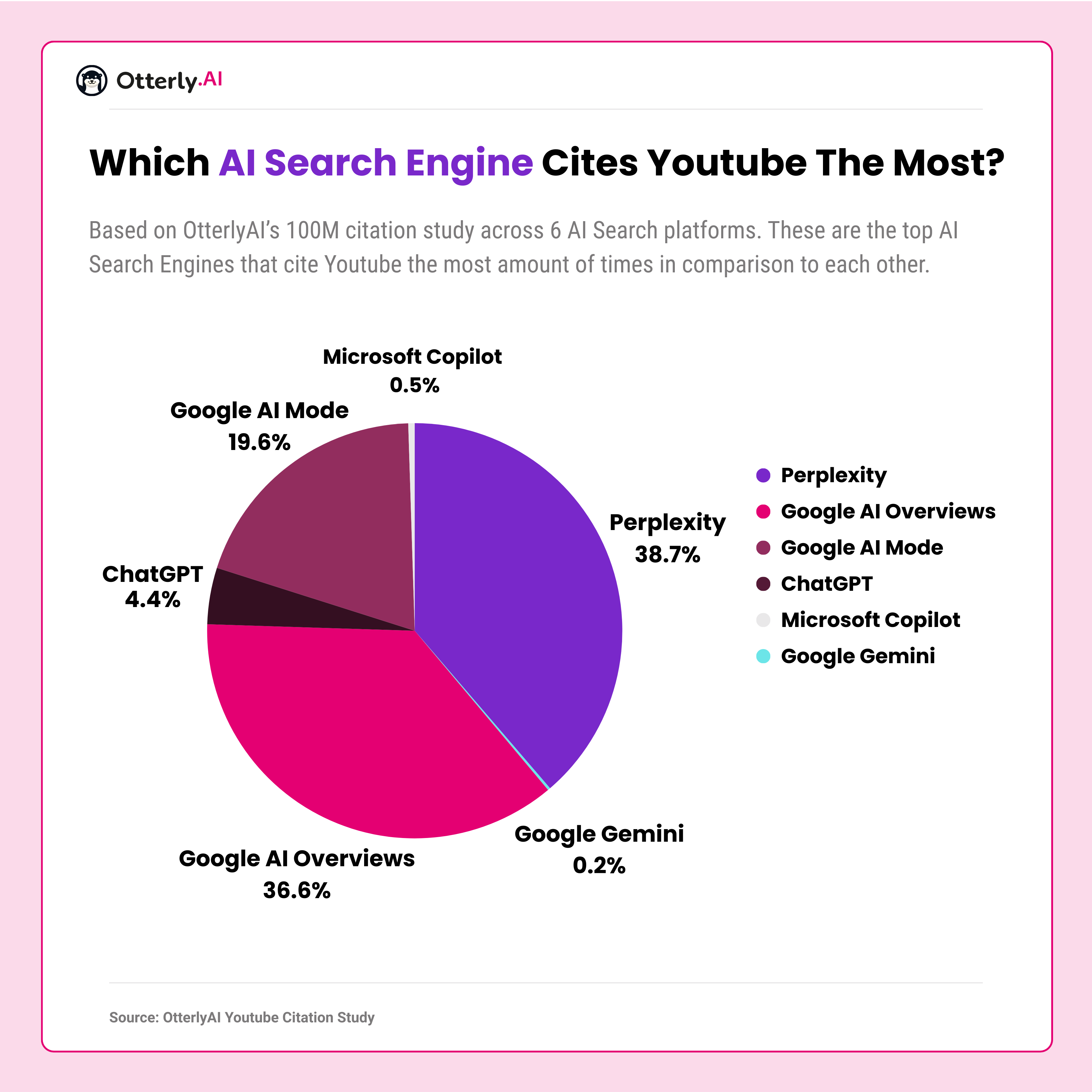
These are the AI Search platforms where YouTube matters the most as of February 2026
Press Inquiries
Thomas Peham
thomas.peham@otterly.ai
https://otterly.ai/


Legal Disclaimer:
EIN Presswire provides this news content "as is" without warranty of any kind. We do not accept any responsibility or liability for the accuracy, content, images, videos, licenses, completeness, legality, or reliability of the information contained in this article. If you have any complaints or copyright issues related to this article, kindly contact the author above.
